Data Communications and Networking ~desitechnocrats.blogspot.com~

11:08 PM / Comments (0) / by Paleoindian

Data Communications and Networking, 3/e provides a comprehensive and current introduction to networking technologies. The book is accessible to students from all backgrounds and uses hundreds of figures to visually represent concepts.

The new edition has been completely updated to reflect the constantly changing world of network technologies. Enhanced coverage of bluetooth, wireless, satellites, as well as four new chapters on security have been added.

The third edition has transitioned from using the 7-layer OSI model to the 5-layer Internet Model. More time is spent on TCP/IP in the new organization.

Forouzan's book continues to be supported by an On-line Learning Center (OLC) that contains many extra resources for students and instructors. Some of the features include PowerPoints, solutions, self-quizzing, and Flash animations that illustrate concepts.

Download

COMPUTER NETWORKS ~desitechnocrats.blogspot.com~

10:42 PM / Comments (0) / by Paleoindian

This is the long-awaited 3rd Edition of Tanenbaum's classic book on computer networking. The finest network engineer I know (who was stolen from my previous employer by developers of IPv6) swears by this book, and it is arguably the best single resource for gaining a good technical understanding of modern networking in the mid 1990s. Very Highly Recommended. --This text refers to an out of print or unavailable edition of this title.

DOWNLOAD

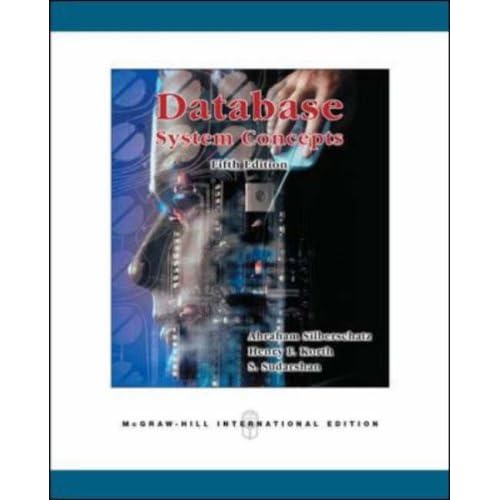
database system concepts

10:01 PM / Comments (0) / by Paleoindian


"Database System Concepts, 4/e", is intended for a first course in databases at the junior or senior undergraduate, or first-year graduate, level. In addition to basic material for a first course, the text contains advanced material that can be used for course supplements, or as introductory material for an advanced course. The authors assume only a familiarity with basic data structures, computer organization, and a high-level programming language such as Java, C, or Pascal. Concepts are presented as intuitive descriptions, and many are based on the running example of a bank enterprise. Important theoretical results are covered, but formal proofs are omitted. In place of proofs, figures and examples are used to suggest why a result is true. The fundamental concepts and algorithms covered in the book are often based on those used in existing commercial or experimental database systems. The aim is to present these concepts and algorithms in a general setting that is not tied to one particular database system. Details of particular commercial database systems are discussed in the case studies which constitute Part 8 of the book. The fourth edition of Database System Concepts retains the overall style of prior editions while evolving the content and organization to reflect the changes that are occurring in the way databases are designed, managed, and used.

Download

Soft Computing

6:45 AM / Comments (0) / by Paleoindian


Learning and Soft computing


This textbook provides a thorough introduction to the field of learning from experimental data and soft computing. Support vector machines (SVM) and neural networks (NN) are the mathematical structures, or models, that underlie learning, while fuzzy logic systems (FLS) enable us to embed structured human knowledge into workable algorithms. The book assumes that it is not only useful, but necessary, to treat SVM, NN, and FLS as parts of a connected whole. Throughout, the theory and algorithms are illustrated by practical examples, as well as by problem sets and simulated experiments. This approach enables the reader to develop SVM, NN, and FLS in addition to understanding them. The book also presents three case studies: on NN-based control, financial time series analysis, and computer graphics. A solutions manual and all of the MATLAB programs needed for the simulated experiments are available.

Download


Fuzzy Logic


Fuzzy logic refers to a large subject dealing with a set of methods to characterize and quantify uncertainty in engineering systems that arise from ambiguity, imprecision, fuzziness, and lack of knowledge. Fuzzy logic is a reasoning system based on a foundation of fuzzy set theory, itself an extension of classical set theory, where set membership can be partial as opposed to all or none, as in the binary features of classical logic.

Fuzzy logic is a relatively new discipline in which major advances have been made over the last decade or so with regard to theory and applications. Following on from the successful first edition, this fully updated new edition is therefore very timely and much anticipated. Concentration on the topics of fuzzy logic combined with an abundance of worked examples, chapter problems and commercial case studies is designed to help motivate a mainstream engineering audience, and the book is further strengthened by the inclusion of an online solutions manual as well as dedicated software codes.

Senior undergraduate and postgraduate students in most engineering disciplines, academics and practicing engineers, plus some working in economics, control theory, operational research etc, will all find this a valuable addition to their bookshelves.

Download

Fundamentals of Neural Networks: Architectures, Algorithms And Applications

Providing detailed examples of simple applications, this new book introduces the use of neural networks. It covers simple neural nets for pattern classification; pattern association; neural networks based on competition; adaptive-resonance theory; and more. For professionals working with neural networks.

Download


Fuzzy sets and logics
Reflecting the tremendous advances that have taken place in the study of fuzzy set theory and fuzzy logic from 1988 to the present, this book not only details the theoretical advances in these areas, but considers a broad variety of applications of fuzzy sets and fuzzy logic as well. Theoretical aspects of fuzzy set theory and fuzzy logic are covered in Part I of the text, including: basic types of fuzzy sets; connections between fuzzy sets and crisp sets; the various aggregation operations of fuzzy sets; fuzzy numbers and arithmetic operations on fuzzy numbers; fuzzy relations and the study of fuzzy relation equations. Part II is devoted to applications of fuzzy set theory and fuzzy logic, including: various methods for constructing membership functions of fuzzy sets; the use of fuzzy logic for approximate reasoning in expert systems; fuzzy systems and controllers; fuzzy databases; fuzzy decision making; and engineering applications. For everyone interested in an introduction to fuzzy set theory and fuzzy logic

Download

SOFTWARE QUALITY ENGINEERING

6:27 AM / Comments (0) / by Paleoindian

Software Quality Engineering: Testing, Quality Assurance, and Quantifiable Improvement


The one resource needed to create reliable software

This text offers a comprehensive and integrated approach to software quality engineering. By following the author's clear guidance, readers learn how to master the techniques to produce high-quality, reliable software, regardless of the software system's level of complexity.

The first part of the publication introduces major topics in software quality engineering and presents quality planning as an integral part of the process. Providing readers with a solid foundation in key concepts and practices, the book moves on to offer in-depth coverage of software testing as a primary means to ensure software quality; alternatives for quality assurance, including defect prevention, process improvement, inspection, formal verification, fault tolerance, safety assurance, and damage control; and measurement and analysis to close the feedback loop for quality assessment and quantifiable improvement.

The text's approach and style evolved from the author's hands-on experience in the classroom. All the pedagogical tools needed to facilitate quick learning are provided:
* Figures and tables that clarify concepts and provide quick topic summaries
* Examples that illustrate how theory is applied in real-world situations
* Comprehensive bibliography that leads to in-depth discussion of specialized topics
* Problem sets at the end of each chapter that test readers' knowledge

This is a superior textbook for software engineering, computer science, information systems, and electrical engineering students, and a dependable reference for software and computer professionals and engineers.

Download


MOBILE COMPUTING

6:15 AM / Comments (0) / by Paleoindian

GSM System Engineering


Here is a comprehensive look at the global system for mobile communications from an engineer's viewpoint. GSM System Engineering covers the architecture, protocols, and time and frequency domain representation, as well as the important issues of network maintenance and management of mobility, subscribers, and security. The book includes explanations of the hardware and software configurations and functions of the mobile switching center, base transceiver station, operations and maintenance center, mobile station sub-systems, the basics of a typical advanced cellular system, an example of an actual Time-Division Multiple Access (TDMA) system, and a look ahead at the industry's future. Includes 200 illustrations.

Downoad


Wireless Ad Hoc Networking


With state-of-the-art research, Wireless Ad Hoc Networking provides wide coverage of key technologies in wireless ad hoc networks including networking architectures and protocols, cross-layer architectures, localization and location tracking, power management and energy-efficient design, power and topology control, time synchronization, coverage issues, middleware and software design, data gathering and processing, embedded network-oriented operating systems, mobility management, self-organization and governance, QoS and real-time issues, security and dependability issues, applications, modeling and performance evaluation, implementation and experience, and much more.

Download

Advanced Computer Architecture

5:42 AM / Comments (0) / by Paleoindian


Advanced Computer Architecture and Parallel Processing


Computer architecture deals with the physical configuration, logical structure, formats, protocols, and operational sequences for processing data, controlling the configuration, and controlling the operations over a computer. It also encompasses word lengths, instruction codes, and the interrelationships among the main parts of a computer or group of computers. This two-volume set offers a comprehensive coverage of the field of computer organization and architecture.

Download


The Sourcebook of Parallel Computing

Sourcebook of Parallel Computing is an indispensable reference for parallel-computing consultants, scientists, and researchers, and a valuable addition to any computer science library. -Distributed Systems Online "The Sourcebook for Parallel Computing gives a thorough introduction to parallel applications, software technologies, enabling technologies, and algorithms. This is a great book that I highly recommend to anyone interested in a comprehensive and thoughtful treatment of the most important issues in parallel computing. " -Horst Simon, Director, Director, NERSC, Berkeley "The Sourcebook builds on the important work done at the Center for Research on Parallel Computation and within the academic community for over a decade. It is a definitive text on Parallel Computing and should be a key reference for students, researchers and practitioners in the field." -Francine Berman, Director, San Diego Supercomputer Center and the National Partnership for Advanced Computational Infrastructure

Download